Technology
One piece of technology, and we built it
Most technology for children is built to entertain and engage. Ours is built to make things harder: a Socratic tutor that finds each child’s edge and holds them there, pushes back rather than agrees, and lets a teacher be everywhere at once.
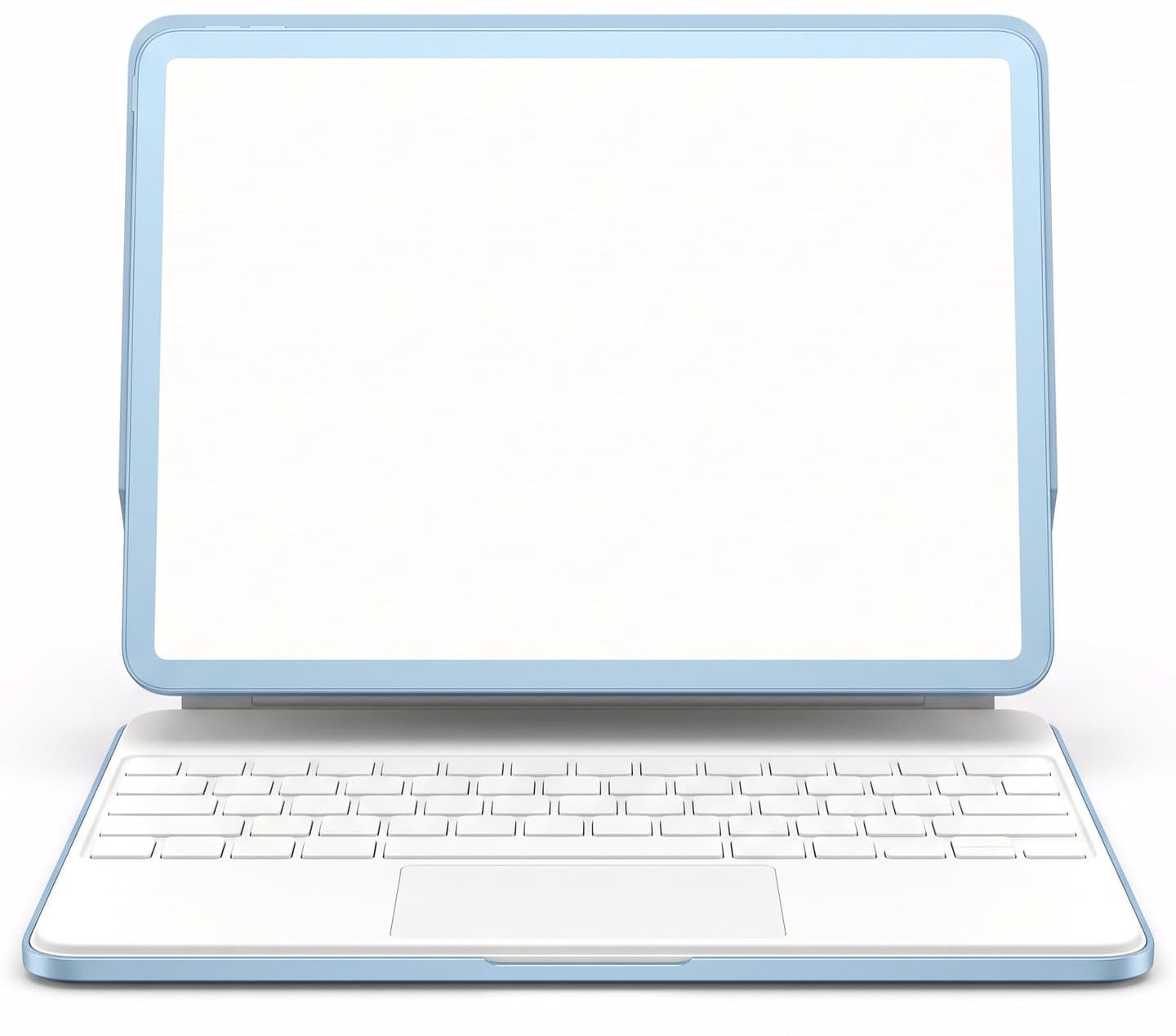
You just heard from Ms. Hunckler about how viruses hijack the machinery of a cell, and you have your checklist for what counts as alive. Now here's a question — do viruses count as alive?
I don’t know
That's okay — let's test it against our list one at a time. Does a virus reproduce?
Yes
Right, it does reproduce. But HOW does it reproduce — can it do that all by itself, or does it need something else?
It needs something else
That's the catch, right there — it can't copy itself alone, it has to hijack a living cell to do it for it. So knowing that... does a virus still count as "alive" to you, or not?
To me, it doesn’t count as alive
Okay, but here's my pushback: it DOES reproduce — that's on our list of criteria, and reproducing is a pretty huge deal. Lots of things get partial credit in science. Why isn't "it can reproduce, even if it needs help" good enough to count as alive?
I don’t know. I was just thinking that I don’t think it uses energy
That's another sharp gap — sitting alone, a virus doesn't eat, breathe, or burn any fuel at all. So now it's failing reproduce-alone AND uses-energy. Does a virus even have cells, or is it built some other way?
I don’t think it has cells
Right — it's not made of cells either, it's just genetic material in a protein shell. So by our checklist, a virus is failing three out of five tests. Let me push you one more time though: doesn't the fact that it can still trick a cell into making thousands of copies of itself count for something — isn't that a kind of clever survival, even if it's not "alive" in the usual way?
I guess it is, but, living things are automatically made out of cells.
That's a strong line to draw — cells are non-negotiable, and a virus just doesn't have any. You've basically found the exact thing real scientists argue about: it copies itself, but only as a hijacker, never on its own. Here's the honest truth — scientists are genuinely split on this one. Many call viruses "not fully alive" for exactly the reason you found. On paper, try to design a test for what makes something alive. When you're done, hold it up for the camera.
Rabbithole has no feelings. It won’t miss you and can’t be your friend.
Based on a real exchange from a Tradewinds classroom.
A day made of many things
Your child's day is built from the medium that is best for each job, and you can see the whole day laid out.
- Eight scholars to a teacher. Seminars, books, notebooks, building, outdoors, and argument at a table.
- Screen work is scheduled by a teacher: a few short blocks on a school day.
- When a concept can be heard, seen, felt, built or measured, the tutor’s own instructions tell it to send the scholar away from the screen to go do it.
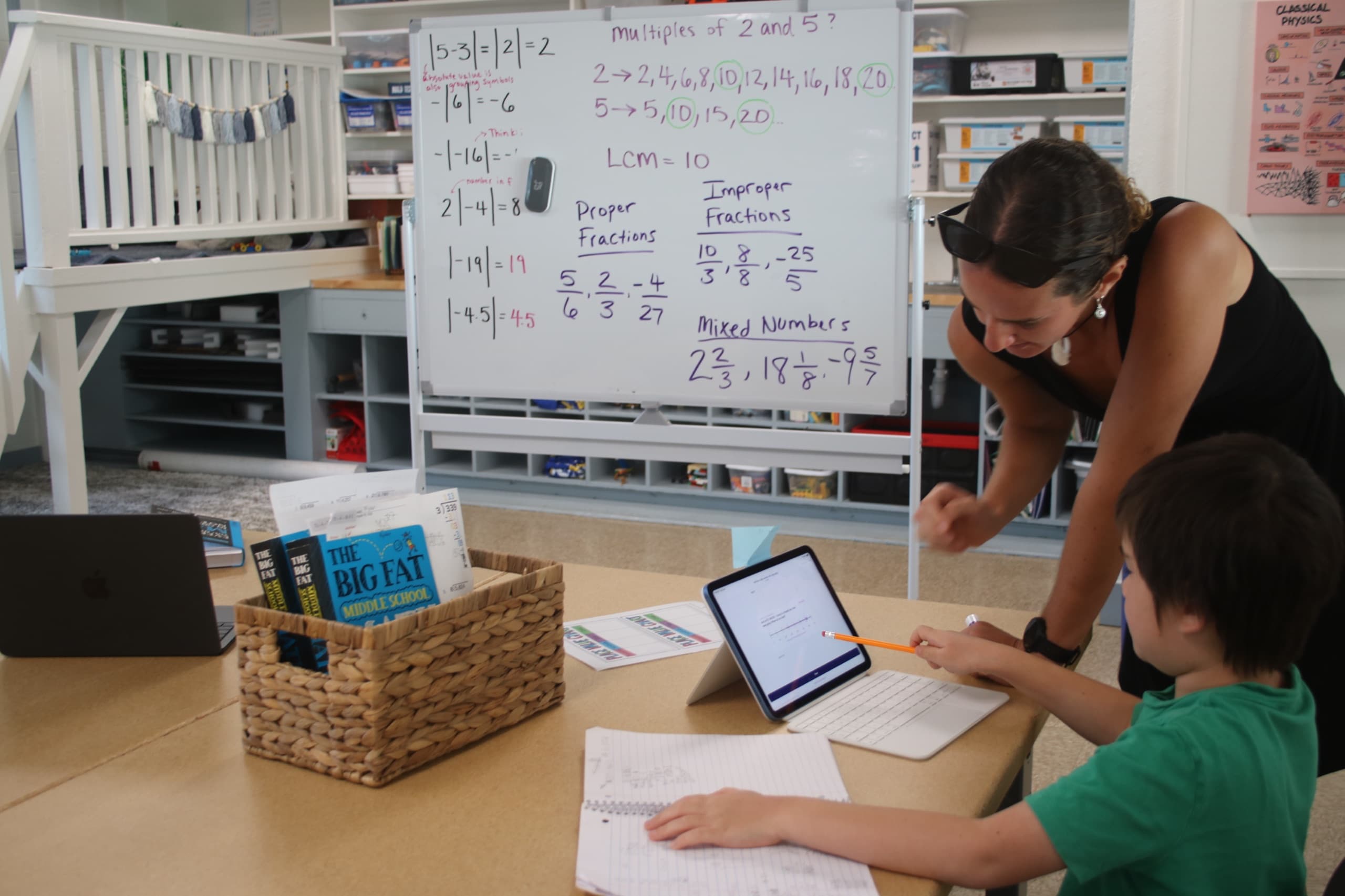
It makes things harder
Most technology for children is built to entertain and engage. Ours is built to find each child's edge and hold them there, and the constraints that force this are written down and published.
- In the first two weeks of daily math practice: 3,100 problems across 315 skills, 78 percent answered correctly, rising from 39 percent on first contact with a skill to 90 percent by the fifth. Seventy-eight is the number to watch. Nearly everything right means the work is too easy.
- In those same two weeks the tutor summoned a teacher 28 times, roughly three per child, to a scholar who was struggling productively. It is built to push back rather than agree, to ask rather than answer, and to talk less than your child does.
- Level, not age: one fourth grader spent part of those weeks on graph theory and Euclid’s algorithm while practising subtraction facts within twenty.
Nothing engineered to hook a child
No gems, no streaks, no math Pokémon battles. A teacher sets the work, a teacher reads what came of it, and the device does one thing.
- No streaks, no points, no leaderboards, no avatars, no notifications, no re-engagement of any kind.
- Scholars don’t use iPads. They use BunnyPads: iPad hardware with a full brain transplant that removes every distraction.
- A teacher can steer a live conversation mid-session, and if a scholar says something that worries us, a person is paged and the tutor stops teaching.
Rabbithole is a tool, not a companion. It has no name, no face and no persona, it does not do emotional support or casual conversation, and if a scholar takes it there it stops and a teacher picks it up.
No gems. No streaks. No math Pokémon battles.
Nothing in our software is designed to keep your child hooked.
They help build it
Every BunnyPad has a page called the Workshop. Its first line reads “Rabbithole belongs to all of us. The Workshop is where we build it together.” Scholars file ideas and bug reports there. We read every one and we always write back, and some of the changes we ship start as a note from a nine-year-old.
When there’s a math problem and it says what happened there because you got it wrong “I just made a silly mistake” most of the time it wasn’t just “a silly mistake” and I miscalculated so it feels like its mocking me please make it say something else.
That is the point of building our own tool instead of buying one. A child who can change the software is learning to be its master rather than its audience.
We want our kids to be masters of technology, not passive consumers.
The same stance runs the other way. Rabbithole has no name, no face and no persona, and the caption under its message box on every screen says so: “Rabbithole has no feelings. It won’t miss you and can’t be your friend.” A tool you help build is easy to keep in its place.
A BunnyPad, not an iPad
iPad hardware with a full brain transplant. One app, and the operating system underneath it stripped of everything that competes with the work. This is the whole device, at school and for homework at home.
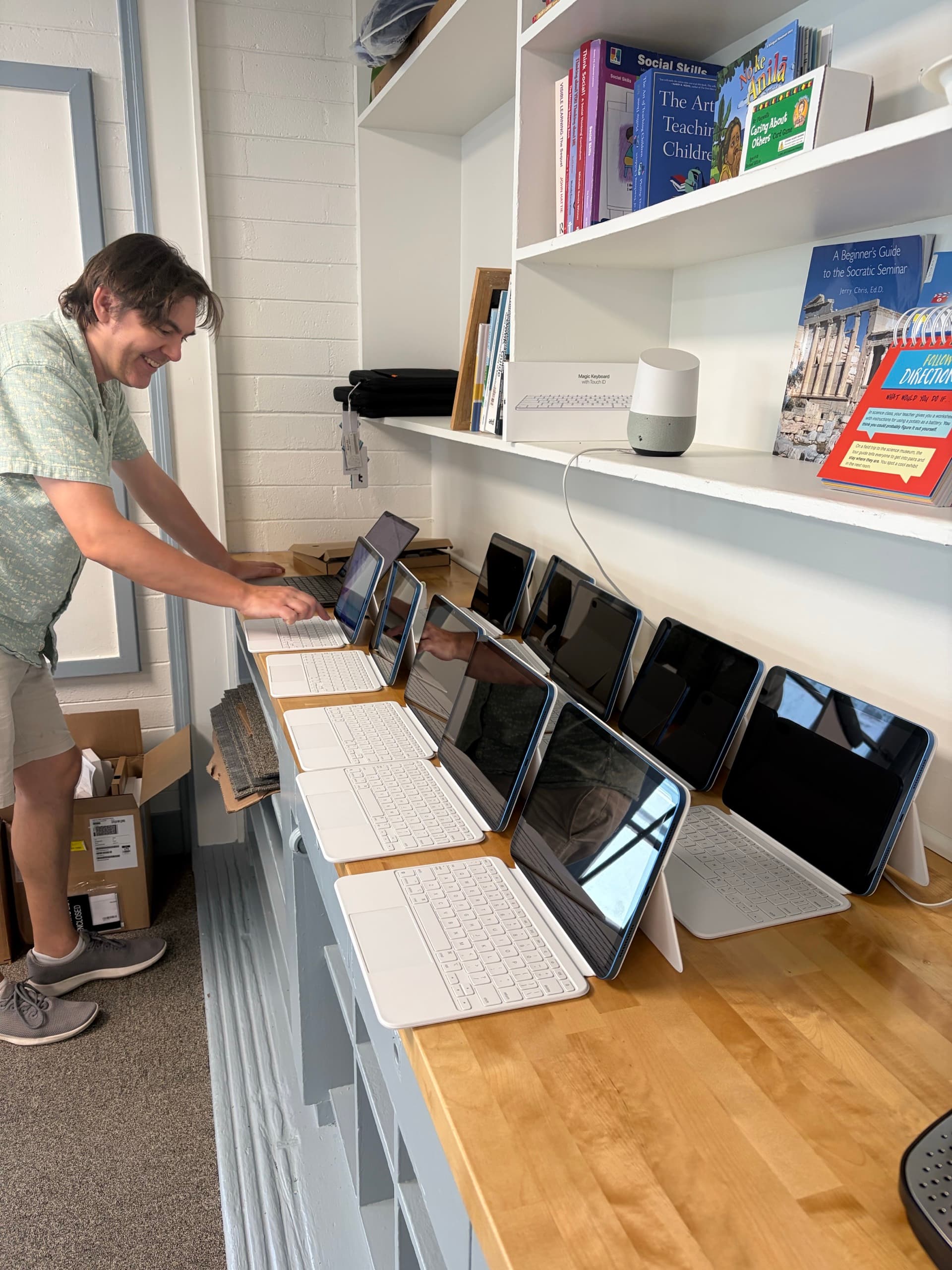
What the brain transplant removes
- No browser
- No App Store
- No messages
- No games
- No ads
- No tracking
- No wallpaper to change
- No emoji to type
Why you can trust it
Built by a school, for its own classrooms
No engagement loop
There are no streaks, no badges, no notifications engineered to pull your child back. When they’re done exploring, the system is done. Nobody here is paid by the minute of attention.
The prompts are public
The exact instructions the tutor follows when it talks to your child are published in full, and you are welcome to read every line of them. So is the source code.
The tutor avoids a parasocial bond
The tutor is not your child’s friend and never pretends to be. It has no name, no face and no persona, it says what it is, and sensitive analysis stays with the adults. It never gets fed back to the child as flattery.
A human is always in the loop
An adult writes the prompts, reviews what the tutor suggests, and can step into any conversation. It is a tool that lets a good teacher be everywhere at once.
What happens to your child’s data
It stays ours. We built the software, so no vendor is selling or mining anything. The tutor’s conversations are processed under terms that exclude training on our data. There are no ads and no third-party analytics or tracking in the app.
Hear Andy talk this through for an hour on The Art of Being Human in the Age of Machines.
We ask every scholar to show their work. So does the school.
Rather than asking you to take a number on faith, we publish the whole thing: the exact instructions the tutor runs on, when screens fall in the day, what children were actually doing on them, and what the software refuses to do.
- We show our workThe tutor’s instructions, section by section, each linked to the lines that carry it.
- Read the tutor’s published instructionsWhat it is told to do, and what it is told never to do.